
Language Is the First Casualty of Exile
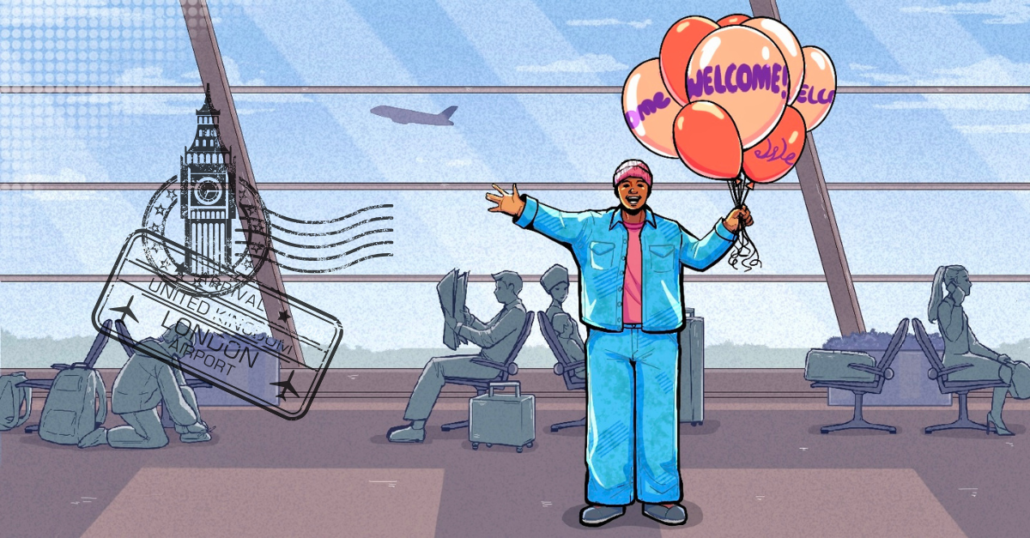
/in ArticlesIonce sketched the outline of a poem at the Heathrow arrivals bay. I was waiting for a friend and his partner, who were relocating to London from Lagos for good. Expectedly, I called the poem ‘Arrivals’, chronicling my own arrival in London on 18 September, 2019. Back then, Uncle instructed me to ride the elevator to the topmost floor to departures, where he was in his Toyota Prius, the standard vehicle for Uber taxis, especially in South London. My uncle was ready to throttle away as soon as I dumped my luggage into the boot. There was something furtive, sneaky, subversive even about paying the five-pound drop-off tax instead of the premium tariff I would spend holding my car in the assigned basement car park while waiting for my friends at the arrivals bay. I would drive them from Hounslow southwards to Forest Hill that wintry evening. This was the equivalent of driving from Lagos to Ibadan but with better roads. I must confess that ‘Arrivals’ could have been a better poem, perhaps because I hesitated to fill it with all of my life’s anxieties and rich biographical details at the time. Instead, I opted for a snapshot of an immutable memory.
It was pitch dark when we arrived at Forest Hill, and I was tired. It was too late for me to travel back home, so I elected to spend the night at my uncle’s residence, a home I refused to sleep in when I moved to London in 2019. The logic behind my choice was the principle of paying it forward. I was revising my arrival experience vicariously. ‘Arrivals’ opens with ‘No one was waiting for you at the Arrivals Bay.’ Choosing to wait for my friend and his partner at the arrivals bay, hurling them many miles away from my home, and sleeping on my uncle’s couch was to give them an immutable memory for the future about their arrival in London. There may have been no placards saying their names, but there was a warm presence, a jovial chauffeur, and a reliable tariff-free sedan, and they were not set back by at least 150 pounds.
A KIND OF KINDNESS
I moved into a one-bedroom flat on Wembley High Road between Covid lockdowns in 2020. It was good riddance to that racist Turkish landlord in Borehamwood, who, in retrospect, may have been a gangster. Parting ways with my brother and sister-in-law, with whom I had lived with for eight months, was not as joyous. They were a newlywed couple who needed privacy to set out on their own terms. Moving to Newcastle was a stretch, but my brother was smiling all the way to the bank with at least 20,000 pounds. Wembley was the first time in my adult life that I would live alone, or so I thought.
In my time in that flat with a fine metallic view of the Wembley Stadium arch, my front room and the two inflatable airbags I purchased were makeshift holiday inn for numerous friends passing through London for reasons that ranged from vacation to weekend revelry to Nigerian passport renewals to family pickups and drop-offs at the Heathrow Airport to international border Covid restrictions. For every request, there was an eager ‘yes’ on the tip of my tongue. And do I love to play host? Lamb chops melted in butter and rosemary sprigs flashed in a griddle pan (my air fryer recipe, too, bangs!). My oxtail pepper soup could closely rival that of Uju of Akerele Extension. I also make a mean smoky Jollof rice. I often joke that if I cannot practice medicine, I may start a Naija restaurant somewhere on some high street in NW London. My longest lodger left me with the most gracious testimony, even though he punctured my first inflatable airbag on his first night with his belt prong. Last Christmas, he hand-delivered a box of chocolate with a handwritten letter written in lush oxytocin-releasing prose. I felt instrumental in making another man’s way in this journey called diaspora.
My wife says acts of service are my love language. It is a firstborn thing, particularly if you are from a Nigerian household or worse, if you are raised by my mother, who bartered with her aunt to babysit her kids in exchange for experiencing the inner walls of a school. I don’t see the ‘service’ in these ‘acts’; I see them as what should be done. As a young boy, my father’s second favourite criticism of my behaviour (the first was my feverish clumsiness) was my ‘lack of initiative’. Daddy, I have gained that initiative in ways that you cannot imagine. Sometimes, it means opening my door, my heart, and every dispensable article in my arsenal in service of others. I suppose this is an invaluable skill for a doctor to possess. A desperate need to help others. Some may call it kindness. And, because I traffic in extremes, my brand is a radical kind of kindness. But I am learning restraint, practising an onlooker’s visage, a sort of tamponade for my effusiveness. My wife is impressed with my progress.
