
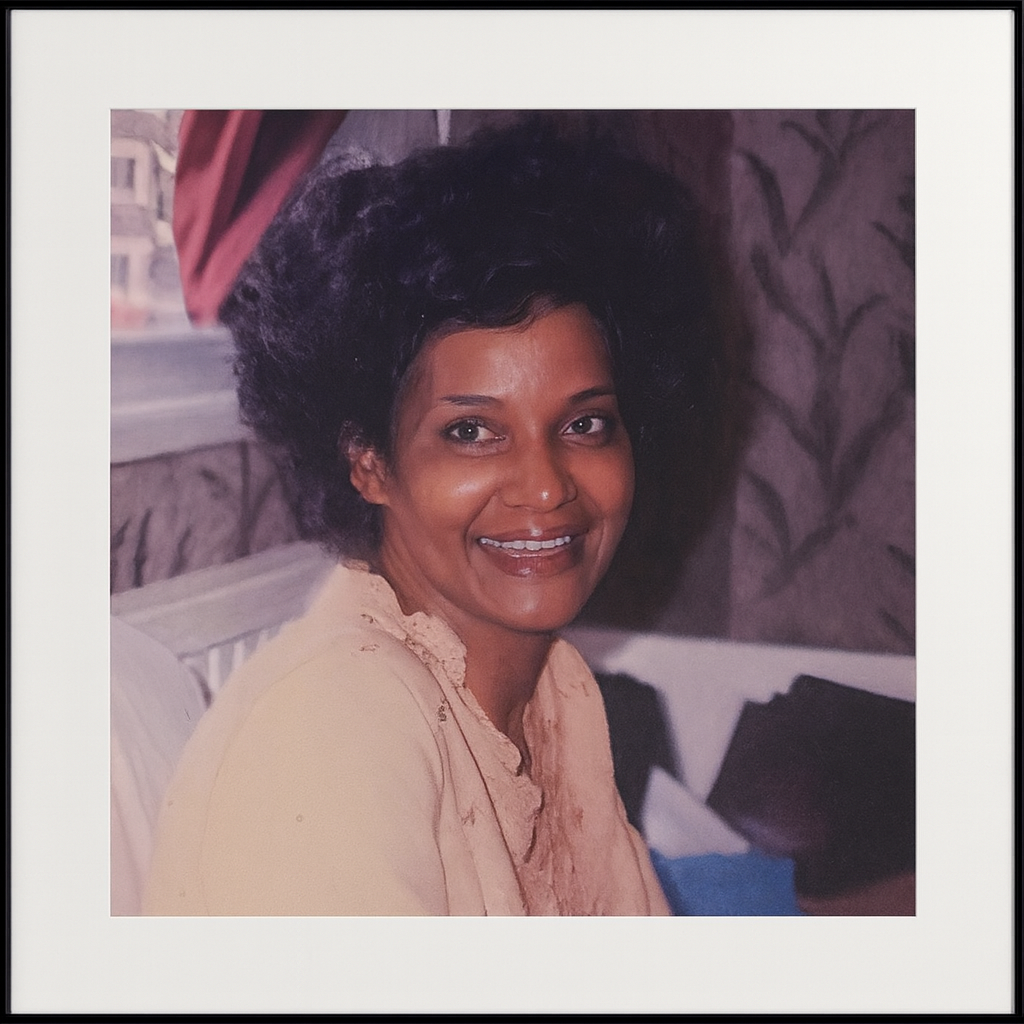
84. If a Home is Made With Love – More reflections on Mrs Kuti, Fela and Afrobeat at Ake Festival
To prepare for my book chat/panel discussion on Mrs Kuti, I read it on my flight to Lagos again. Unlike my first read, the second read was not brisk; it was illuminating. It felt like I was reading a different book. I went in looking for Fela on my first read—his jovial self, his wicked charm, his prodigious talent. Then I wanted to understand how his first wife, Remi Kuti, perceived his music. I wanted to understand what she made of his political consciousness and philosophy, which he communicated externally in his lifestyle and lyrical choices in his music and manifesto.
My second read illuminated Mrs Kuti’s manifesto. It also offered me a powerful critique of Fela’s social experiment, Kalakuta Republic. In her memoir, Mrs Kuti declared Kalakuta a failed experiment, but she stood by Fela’s philosophy, which shaped her own choices, particularly leaving Fela. Armed with Fela’s philosophy, she changed the world on her own terms by focusing on family and her children. She made a haven of that private space we often call home.
Mrs Kuti had a traumatic childhood. She was of Indian American, British and Nigerian heritage. Her parents split up when she was 4. Her lawyer father, from a prestigious Lagos family, died before she was a teenager. She was ferried off to a Children’s Home in the English Midlands, aged 12, where she lived till age 18. At 19, she met a gregarious trumpeter and band leader, Fela, to whom she was attracted, and she married within a year.

Three children would follow in rapid succession, then she left England for Nigeria to make a life with her musician husband in postcolonial Lagos. The early parts of the book dealt with her childhood in England after the Second World War. England was still impoverished, recovering from an expensive war that it had won. Racism was rife. The English at the time, like now, accepted only a token population of Black immigrants. This may trigger her disillusionment with life in England, nudging her towards life in Nigeria. Also, she was in love, and love is a powerful incentive to elope.
Nigeria (and Africa) in the 60s was on the rise. Optimistic about its independence, a country of many tribes yoked by colonial connective tissue approached freedom from the Brits like the Yoruba proverb about first getting rid of the panther, after which you address the hen. Most accounts of Fela’s life in the 60s gloss over the Biafran war. He was a young father, bandleader and an irresponsible radio journalist always in trouble with management. Little wonder, he skipped to America on an eight-month sojourn in 1969 when he was opportuned.
We know that he developed his political consciousness when he met Sandra Izsadore. In preparing for my discussion, I attempted to read Sandra’s memoir, Fela and Me. My understanding was that it was self-published and one had to order from her directly on the website, pay the book cost plus the cost of international delivery. I did not have either the luxury of time or money.

Remi Kuti notes in her book that Fela changed when he returned from America. “Before his trip abroad, he had a child-like open face, now it had signs of wear and tear, of stress, all the signs a man gets when life shows its hard side.” Sandra has spoken extensively about what she thought of Fela’s early music. Singing about soup was hilarious to her. Love songs and other mundanities that filled his oeuvre did not impress her. Fela’s first manager and Burna Boy’s grandfather, in his memoir, noted that My Lady Frustration was written for Sandra, but we know that his first significant hit, ‘Jeun Koku, which explored gluttony as social commentary, was also about food!
What exactly is my point? Fela’s young country went to war against itself. Fela experienced America and saw firsthand the Civil Rights Movement. His mother was a prominent activist. All of these events and pedigree must have coaxed his music in the direction of protest. Recall that during the Civil War, he re-recorded one of his love songs as dub poetry supporting Nigeria’s unity, Viva Nigeria. But in Fela lore, myth is rife, and Sandra Izsadore is overrepresented.
Remi Kuti is given a short, inconsequential chapter in Carlos Moore’s book on Fela, This B*tch Called Life. She appeared tight-lipped and two-dimensional in that interview. Mrs Kuti was Remi Kuti claiming her rightful place in the Afrobeat pantheon.
What is her claim, you may ask? Well, she was the mother of three of Fela’s children. Yeni Kuti, his eldest child and daughter, has been instrumental in protecting Fela’s legacy. Femi Kuti, his first son and second child, is the foremost Afrobeat musician after Fela. His take on Afrobeat is unique, and we cannot discuss his son, Made, Fela’s grandson, without Femi, who has held his hand into becoming the amazing multi-instrumentalist and composer he is.

When Fela gave himself to his activism/music/social experiment at Kalakuta Republic, Remi raised his children single-handedly. She nurtured them with love and gave them the stability they deserved to face the world as the offspring of a controversial and often vilified musician. That role has always been undercelebrated in Afrobeats lore, this is why her book, Mrs Kuti, is so seminal. Published 23 years after she became an ancestor and almost forty years after she put pen to paper, we hear eloquently from Mrs Kuti and see the world through her eyes.
It was a moving panel. Left me thinking about my own childhood and how trauma, if unprocessed, could be dispatched and paid forward. During the Q&A, a young lady was particularly enthusiastic and persistent in her line of questioning (check the video below from the one-hour mark). She felt Mrs Kuti was not well represented in the discussion. My immediate response was to ask her to read the book—the perfect solution to her unfair complaint. But watching the panel back, I believe she was mistaken: this deeply emotional panel centred Remilekun Kuti and worked hard to sidestep the looming figure in the room, Fela.
In the years to come, the Afrobeat discourse will centre other figures and their contributions, particularly the women surrounding Fela.

Read my first review of Mrs Kuti, here
Read my review of Made Kuti’s second album here
Read my review of Made Kuti’s first album here
Read my latest reflection on Fela Kuti here
Read my report of visiting the Afrika Shrine here

